Why Most Gulf Currencies Are Pegged to the U.S. Dollar
Why Most Gulf Currencies Are Pegged to the U.S. Dollar
The exchange rates of most Gulf currencies barely move against the U.S. dollar.
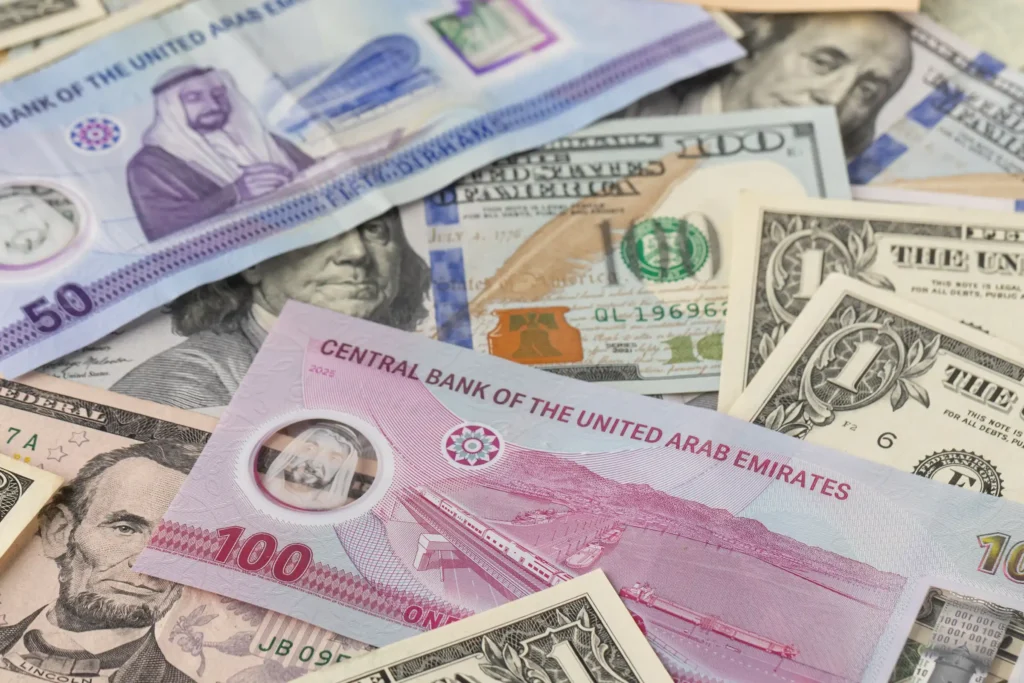
The UAE dirham is maintained at about Dh3.6725 to the dollar. Saudi Arabia keeps the riyal at SAR3.75 per dollar, while Qatar maintains the Qatari riyal at QR3.64 per dollar. Bahrain and Oman also maintain fixed exchange-rate relationships with the U.S. dollar.
Kuwait is the exception. The Kuwaiti dinar is pegged to an undisclosed basket of currencies rather than directly to the dollar, although the U.S. currency remains highly important to the country’s exchange-rate system.
These arrangements are not accidental. They reflect a policy choice that has shaped Gulf monetary systems for decades.
The central question is, therefore, not simply why the Gulf uses the dollar. It is why policymakers have considered a stable exchange rate against the dollar more valuable than having completely independent exchange-rate and monetary policy.
The Dollar Became the Natural Anchor for Gulf Economies
The Gulf’s relationship with the dollar is closely connected to the region’s role in global energy markets.
Oil and gas exports have historically generated substantial dollar revenues for Gulf economies. Saudi Arabia’s central bank, for example, has previously noted that most of the country’s exports were denominated in dollars and that many imports were also invoiced in dollars.
That creates an important economic advantage when the domestic currency is stable against the dollar.
A government receiving dollar revenue from energy exports does not have to deal with large swings in the value of those revenues caused by movements between its domestic currency and the dollar.
The same applies to businesses that buy goods, equipment, or services priced in dollars.
The relationship goes beyond oil, however.
The dollar is the dominant currency in international finance, global commodity markets, and cross-border transactions. Gulf banks, companies, and governments are therefore operating in an environment where the dollar already plays an unusually large role.
A fixed exchange rate makes that relationship easier to manage.
What a Currency Peg Actually Means
A currency peg means that a central bank commits to maintaining its currency at a particular exchange rate, or within a defined range, against another currency or group of currencies.
It is different from a freely floating currency.
If the UAE dirham were freely floating, its value against the dollar would be determined primarily by foreign exchange market conditions.
Instead, the Central Bank of the UAE actively maintains the dirham’s dollar parity. The CBUAE says it intervenes automatically in the foreign exchange market to prevent capital inflows or outflows from moving the exchange rate away from its parity.
The mechanism is straightforward.
When market forces create pressure that could push the currency away from its target, the central bank can buy or sell foreign currency and conduct other monetary operations to support the exchange-rate regime.
This requires reserves and a credible policy framework.
The CBUAE explains that maintaining the dirham’s fixed exchange rate requires liquid foreign-currency reserves with which it can intervene in the market.
Why Exchange-Rate Stability Matters to Gulf Economies
For a company operating internationally, exchange-rate volatility can change the cost of doing business even when the underlying price of a product has not changed.
Consider a Gulf importer that needs to pay a U.S. supplier $10 million.
If its domestic currency falls sharply against the dollar, the local-currency cost of that payment rises.
With a stable dollar exchange rate, that particular source of uncertainty is greatly reduced.
The same principle applies to banks and governments with dollar-denominated transactions.
A predictable exchange rate makes financial planning easier.
It also gives companies greater certainty when preparing budgets, pricing contracts, and assessing foreign investments.
This is one of the practical reasons the Gulf’s exchange-rate arrangements have remained important even as the economies themselves have become more diversified.
The Peg Helps Anchor Monetary Policy
The dollar peg also serves a monetary-policy function.
The International Monetary Fund describes the GCC exchange-rate pegs as important nominal anchors for monetary policy and says they have supported macroeconomic and financial stability across the region.
A nominal anchor essentially gives an economy a reference point for monetary stability.
Instead of allowing the exchange rate to fluctuate substantially, policymakers commit to maintaining a defined relationship with the dollar.
That commitment can help shape expectations among households, businesses, and financial markets.
If people believe the exchange rate will remain stable, they have less reason to expect sudden currency depreciation to feed into domestic prices.
This does not mean a dollar peg eliminates inflation.
Food, housing, wages, transportation, rents and other domestic costs can still rise.
But exchange-rate stability can remove one potentially significant source of price volatility, particularly for imported goods.
The Dollar Peg Comes With a Major Trade-Off
The strongest argument against a hard dollar peg is also the most important thing investors need to understand.
A country can not simultaneously maintain a rigid exchange rate, allow capital to move freely across its borders, and have complete freedom to set its own monetary policy.
The three objectives create a fundamental policy constraint.
For Gulf countries with direct dollar pegs, that means interest-rate policy is closely connected to the Federal Reserve.
The IMF states that for most GCC countries, maintaining the dollar peg entails matching policy-interest-rate changes by the Fed.
This explains why Federal Reserve decisions matter so much in Gulf financial markets.
The Federal Reserve sets interest rates according to conditions in the U.S. economy.
But when the Fed changes rates, Gulf central banks have to consider the implications for their own exchange-rate arrangements.
Why Gulf Interest Rates Often Follow the Fed
Suppose the Federal Reserve raises U.S. interest rates significantly while a Gulf central bank with a hard dollar peg keeps domestic rates substantially lower.
The difference between the two markets can affect capital flows and the attractiveness of holding dollar-linked assets.
That can create pressure on the exchange-rate regime.
For a central bank committed to defending the peg, maintaining an appropriate relationship between domestic and U.S. interest rates can, therefore, become important.
This does not mean the Federal Reserve directly controls Gulf monetary policy.
It means the exchange-rate regime limits how independently Gulf central banks can move.
The IMF’s 2025 GCC assessment illustrates the relationship. It found that monetary policy across most GCC economies continued to track the Federal Reserve in the context of maintaining exchange-rate pegs. Kuwait was the main exception because its currency is linked to a basket rather than directly to the dollar.
What Happens When the U.S. Dollar Strengthens?
There is another consequence of the system that is easy to overlook.
If a Gulf currency is fixed to the dollar, it will effectively move with the dollar against other currencies.
Suppose the dollar strengthens against the euro.
The UAE dirham also becomes stronger against the euro because the dirham’s value is fixed against the dollar.
The same principle applies to the Saudi riyal and Qatari riyal.
That can affect trade.
European goods priced in euros may become cheaper in dirham or riyal terms when the dollar strengthens against the euro.
At the same time, Gulf products sold into markets whose currencies have weakened against the dollar can become relatively more expensive for those foreign buyers.
So, a dollar peg provides stability against the dollar, but it does not eliminate exchange-rate movements against the rest of the world.
Why the Gulf Has Not Simply Let Its Currencies Float
A floating currency would give Gulf central banks more room to respond directly to domestic economic conditions.
But it would also introduce greater exchange-rate uncertainty.
That matters because Gulf economies remain heavily integrated with international trade and finance.
A sharp depreciation would increase the local-currency cost of imports priced in dollars.
A sharp appreciation could reduce the local-currency value of dollar revenues.
Companies with foreign-currency liabilities could also see their debt becoming more expensive in domestic-currency terms if the local currency weakened.
For economies that have historically earned substantial foreign exchange from hydrocarbons and operate extensively in dollar-based international markets, policymakers have judged the stability offered by the peg to be valuable.
The IMF continues to describe the GCC exchange-rate pegs as appropriate nominal anchors and says they have supported macroeconomic and financial stability.
Foreign-Exchange Reserves Are Critical
A peg is only credible if markets believe the central bank has the ability and willingness to defend it.
That makes foreign exchange reserves an important part of the system.
The central bank can use its foreign-currency assets when market conditions create pressure on the exchange rate.
The UAE provides a clear example.
The CBUAE says it maintains foreign-exchange operations specifically to preserve the dirham’s dollar parity and requires liquid foreign-currency reserves to support intervention.
Saudi Arabia has similarly emphasized the role of foreign exchange reserves and monetary-policy instruments in supporting its SAR3.75-per-dollar exchange-rate policy.
This is why the strength of a peg can not be judged simply by looking at the exchange rate.
A stable exchange rate is the visible result.
The reserves, fiscal position, banking system, and credibility of the central bank are part of what supports it underneath.
Saudi Arabia’s Riyal Shows How Long the System Can Last
Saudi Arabia is one of the clearest examples of the durability of the Gulf’s dollar-based system.
The Saudi riyal has been effectively pegged at SAR3.75 per U.S. dollar since 1986. Saudi Central Bank continues to list the dollar exchange rate at 3.7500.
SAMA describes the exchange-rate policy as a strategic choice and an anchor of monetary and financial stability.
The significance is not merely historical.
A long-standing peg can shape the behaviour of an entire financial system.
Banks price loans and deposits with the exchange-rate regime in mind. Businesses make investment decisions knowing the dollar relationship is expected to remain stable. Investors incorporate the currency arrangement into their assessment of Gulf assets.
The longer the system remains credible, the more deeply it becomes embedded in economic decision-making.
The UAE Dirham Works on the Same Principle
The UAE is another clear example.
The CBUAE explicitly describes the fixed exchange rate of the dirham against the U.S. dollar as a monetary-policy objective.
Its current foreign-exchange operations use intervention rates of approximately 3.672 to 3.673 dirhams per dollar, while the official exchange-rate table shows the dollar at Dh3.6725.
The central bank’s own explanation also shows how the peg affects the monetary base.
When foreign capital flows into the UAE, the central bank can intervene to prevent the dirham from appreciating beyond the targeted parity. That intervention changes the central bank’s foreign reserves and banking-system liquidity.
This is an important point because it shows that a currency peg is not simply an exchange-rate announcement.
It affects the operation of monetary policy and the banking system itself.
Qatar uses the dollar as a formal monetary Anchor
Qatar provides another straightforward example.
The Qatar Central Bank states that its formal exchange-rate framework is a fixed parity of QR3.64 per U.S. dollar.
It also explicitly says monetary policy is implemented with the objective of maintaining that fixed parity.
Qatar formally authorized the dollar peg in 2001, replacing the previous formal arrangement involving the IMF’s Special Drawing Rights.
The important point is that Qatar’s monetary framework is designed around the exchange-rate target rather than treating the currency as a freely floating asset.
related article
- What a September Fed Rate Hike Could Mean for Gulf Stocks, Banks and Investors.
- Gulf equities came under pressure as investors reassessed the U.S. interest-rate outlook
Kuwait Is the Important Exception
Kuwait deserves separate treatment because it demonstrates that the Gulf does not operate under one identical exchange-rate system.
The Kuwaiti dinar is pegged to an undisclosed basket of currencies.
The IMF classifies Kuwait’s de jure exchange-rate arrangement as a conventional peg to that basket.
This gives Kuwait somewhat more monetary-policy autonomy than countries with direct dollar pegs.
The IMF has specifically noted that Kuwait’s basket arrangement gives the country some room to pursue macroeconomic stabilization objectives while still tracking the Federal Reserve and other major central banks.
Kuwait’s system, therefore, should not be described as a simple dollar peg.
Its currency remains closely connected to the dollar-dominated global financial system, but the exchange-rate anchor is broader.
For investors, the dollar peg changes the nature of currency risk rather than eliminating financial risk.
An investor holding a UAE or Saudi asset does not face the same degree of direct dollar-exchange-rate volatility that would exist in a country with a freely floating currency.
But other risks remain.
Interest rates can rise.
Bond yields can increase.
Bank funding costs can change.
Equity valuations can fall.
Property financing can become more expensive.
And changes in U.S. monetary policy can affect liquidity and borrowing conditions across Gulf markets.
The IMF’s analysis is particularly relevant here: maintaining the dollar peg means monetary policy in most GCC economies generally has to move in step with the Federal Reserve.
For investors, therefore, understanding the Gulf’s currency system also means understanding the Federal Reserve.
The Real Economic Trade-Off
The Gulf’s dollar-peg system can be reduced to a simple policy trade-off.
The benefit is stability.
Businesses, governments, banks, and investors get a highly predictable exchange rate against the world’s most important international currency.
That can reduce currency and uncertainty, support financial planning, and provide a clear monetary anchor.
The cost is reduced monetary independence.
Central banks with hard dollar pegs can not freely ignore major changes in the U.S. interest rates without considering the implications for their exchange-rate commitments.
That trade-off is particularly important during periods of aggressive Federal Reserve tightening or easing.
A Gulf central bank may face domestic economic conditions that are different from those in the United States, yet the exchange-rate regime can still constrain how far its interest-rate policy can diverge from the Fed.
Why Most Gulf Currencies Remain Tied to the Dollar
The Gulf’s dollar-based exchange-rate system is ultimately the product of several forces working together.
The region’s energy exports have historically been strongly connected to dollar-based international markets.
The dollar is deeply embedded in global trade and finance.
Gulf governments and businesses benefit from predictable exchange rates for international transactions.
Central banks use the exchange-rate arrangement as a monetary-policy anchor.
And decades of maintaining the system have created credibility around the exchange-rate commitments.
The result is a system in which the Gulf gets substantial exchange-rate stability but accepts a closer monetary relationship with the United States.
That is the real reason most Gulf currencies remain tied to the dollar.
It is not simply because oil is sold in dollars.
It is because the dollar has become deeply integrated into the Gulf’s trade, financial markets, reserves, and monetary-policy framework.
For investors and businesses operating in the region, understanding that relationship is essential. A Federal Reserve rate decision may be made for the U.S. economy, but through the dollar-peg system, its effects can travel directly into Gulf interest rates, financing conditions, and financial markets.
Source: IMF





