What a September Fed Rate Hike Could Mean for Gulf Stocks, Banks and Investors.
What a September Fed Rate Hike Could Mean for Gulf Stocks, Banks and Investors
AUGUST 30 2026 | Makon Financials Deep Analysis | Victor Brooks and Felix Matins
Expectations for a U.S. Federal Reserve rate hike in September has risen sharply following comments from Fed Chair Kevin Warsh at the Jackson Hole Economic Symposium.
Markets were pricing a 55.7% probability of a September rate increase on Friday, up from 35.4% before Warsh’s remarks, according to CME FedWatch data cited by Reuters. Gulf stocks subsequently came under pressure, with Saudi Arabia’s benchmark index falling 0.7% on Sunday and Qatar’s index declining 0.1%.
The Federal Reserve’s next policy meeting is scheduled for September 15–16. A rate increase is not guaranteed, however. The decision will depend on economic data available before the meeting.
For Gulf investors, the issue goes beyond the Fed’s decision itself. Changes in U.S. interest rates can affect local borrowing costs, bank funding conditions, stock valuations, and the relative attractiveness of different investments.
Gulf Stock Valuations
Interest rates matter when investors value stocks because the return available from relatively low-risk assets is part of the calculation investors make when deciding how much they are willing to pay for equities.
If U.S. interest rates rise, and treasury yields can become more attractive relative to riskier assets. That can increase the return investors require from stocks.
For Gulf markets, the connection with U.S. monetary policy is particularly important because the currencies of Saudi Arabia, the UAE, and Qatar are fixed or pegged to the U.S. dollar.
Saudi Arabia maintains the riyal at SAR3.75 per dollar, according to the Saudi Central Bank.
The UAE’s central bank says its base rate is anchored to the Federal Reserve’s Interest on Reserve Balances.
Qatar maintains a fixed parity of QR3.64 per U.S. dollar, with its monetary-policy framework focused on maintaining that exchange-rate arrangement.
That means a change in the U.S. rates have a direct relevance for monetary conditions in these markets.
It does not mean every Gulf stock should fall if the Fed raises rates. The effect will depend on individual companies, their earnings, debt levels, and how much of the expected rate increase is already reflected in share prices.
The immediate market reaction can also be different from the longer-term effect. If investors have already positioned a hike, the actual decision may produce a smaller move than a surprise change in expectations.
Bank Profitability
Banks are one of the sectors most closely connected to interest rates.
When interest rates rise, banks can earn more on some interest-bearing assets, including loans. But their funding costs can rise as well.
Deposit rates are an important part of this equation. If banks have to pay more to attract or retain deposits, the additional income from higher lending rates can be partly offset.
The result depends on the difference between what banks earn on their assets and what they pay for funding.
Higher rates can also affect loan demand. Borrowing becomes more expensive, which can influence decisions by companies and households.
For investors in Gulf banks, the important figures will therefore include net interest income, deposit costs, loan growth, and asset quality rather than simply the headline profit number.
A rate increase by itself does not establish whether a particular bank will become more or less profitable.
Foreign Investor Flows
U.S. interest rates can also affect how international investors allocate capital.
When Treasury yields rise, dollar-denominated fixed-income assets can offer higher returns. Investors comparing Gulf equities with U.S. bonds and other global assets may, therefore, reassess the amount of risk they are willing to take.
That does not mean foreign investors automatically sell Gulf shares after a Fed hike.
Gulf stock markets can still attract international capital when investors see sufficient potential in company earnings or valuations. The direction of foreign flows depends on several factors, including expected returns, market valuations, and global risk appetite.
The current market reaction shows that expectations themselves can influence Gulf equities before the Fed makes any decision. Reuters reported that Gulf stocks fell after the rise in expectations for a September hike.
Borrowing Costs
Higher U.S. rates are particularly relevant to Gulf borrowers because of the region’s dollar-linked monetary systems.
The UAE provides a clear example. The Central Bank of the UAE states that its base rate is anchored to the Federal Reserve’s Interest on Reserve Balances.
In Qatar, the central bank’s exchange-rate framework is based on a fixed parity of QR3.64 to the dollar.
Saudi Arabia maintains its riyal at SAR3.75 per dollar.
For companies and households, higher interest rates can mean higher costs on loans whose pricing moves with benchmark rates.
For companies that rely heavily on borrowing, the cost of refinancing can, therefore, become an important financial consideration.
The effect will differ between borrowers because debt structures vary. A company with mostly fixed-rate, long-term borrowing will not experience the same immediate effect as one that relies heavily on short-term or floating-rate debt.
Liquidity
Interest rates also influence liquidity in financial markets.
When the cost of money increases, banks and other financial institutions operate in a different funding environment. Central banks in the Gulf manage domestic monetary conditions while maintaining their exchange-rate arrangements.
The UAE central bank describes its base rate as the prevailing official monetary-policy rate and says it provides an effective interest-rate floor for overnight money-market rates in the UAE.
Qatar’s monetary framework is similarly centred on maintaining the riyal’s fixed relationship with the U.S. dollar.
For investors, the important point is that tighter interest-rate conditions can change the cost and availability of financing.
That can affect trading activity, borrowing decisions, and the valuation investors place on financial assets.
Saudi Arabia
Saudi Arabia’s monetary conditions are closely connected to the dollar through the riyal’s SAR3.75 exchange-rate arrangement. The Saudi Central Bank describes the fixed exchange rate as an anchor for monetary and financial stability.
That makes U.S. monetary policy is an important factor for Saudi investors.
The Saudi stock market already responded to the latest change in Fed expectations. The Tadawul All Share Index fell 0.7% on Sunday, while Saudi National Bank declined 1.2% and Saudi Arabian Mining fell 3.3%, according to Reuters.
Those moves do not establish that the stocks will continue falling. They show that changing expectations about the U.S. interest rates were being reflected in the market.
UAE Markets
The UAE’s connection with U.S. monetary policy is also direct.
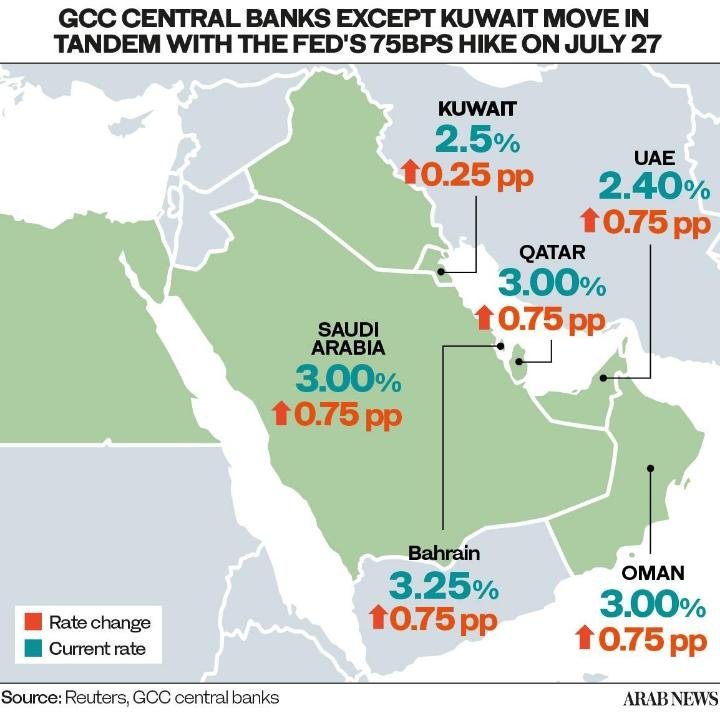
The Central Bank of the UAE says its base rate is anchored to the Federal Reserve’s Interest on Reserve Balances.
Consequently, a change in the U.S. rates are relevant to UAE interest rates and domestic financing conditions.
For UAE-listed companies, investors would need to consider the effect of higher financing costs alongside each company’s earnings and balance sheet.
Banks may see changes in both lending income and funding costs. Companies with significant borrowing may face higher interest expenses when debt is repriced or refinanced.
The effect on the wider stock market will depend on how investors value those changes.
Qatar Markets
Qatar’s monetary policy also operates within a fixed exchange-rate framework.
Qatar Central Bank states that the riyal is maintained at QR3.64 per U.S. dollar and that the exchange rate is the formal anchor of its monetary-policy framework.
That makes changes in the U.S. interest rates relevant to Qatar’s domestic financial conditions.
Qatar’s stock market also reacted to the latest shift in Fed expectations. The benchmark index fell 0.1% on Sunday, according to Reuters. The decline included weakness in major financial stocks, while some energy-linked shares rose.
The mixed performance within the market is important. A change in interest rates does not affect every company in exactly the same way.
RELATED ARTICLES
- Gulf equities came under pressure as investors reassessed the U.S. interest-rate outlook
- Rising Bond Yields Add Billions to G7 Borrowing Costs as Debt Pressure Builds
What Investors May Watch Before the Fed Meeting
The September decision will come after several important U.S. economic releases.
Inflation
Inflation will remain one of the main issues for monetary policy.
Warsh used his Jackson Hole speech to emphasize the Fed’s commitment to bringing inflation back toward its 2% target.
Investors will, therefore, watch the next inflation readings for evidence of whether price pressures are moving in the direction the Fed wants.
Employment
The U.S. labour market will also be important.
Employment data can influence the Fed’s assessment of economic conditions and, therefore, expectations for interest rates.
The market has already shifted its expectations for September following Warsh’s remarks, meaning incoming economic data could move those expectations again.

Treasury Yields
U.S. Treasury yields are another important indicator for Gulf investors.
Short-term Treasury yields are particularly sensitive to expectations for Fed policy. A continued rise in yields could influence the relative attractiveness of stocks and other risk assets.
Bank Funding Costs
Gulf investors should also watch bank deposit costs, lending growth, and net interest margins.
The question is not simply whether rates are higher. It is how quickly banks’ income and funding expenses respond to those changes.
Oil Prices
Oil prices remain an important variable for Gulf markets because of the role of the energy sector in the economies of Saudi Arabia and Qatar and the wider regional financial system.
Investors will, therefore, be watching oil markets alongside the U.S. interest-rate expectations rather than treating the Fed decision in isolation.
The Key Question for Gulf Investors
A September rate hike would not provide a simple buy-or-sell signal for Gulf stocks.
The more important question is how the market reaches the decision.
If expectations continue changing before September 15–16, Gulf assets can respond before the Fed announces anything. If the Fed raises rates and the decision matches what markets already expect, the reaction could be different from a situation in which policymakers deliver an unexpected move or a different outlook for future rates.
For Gulf investors, the transmission channels are relatively clear: U.S. rates affect dollar-linked monetary conditions, borrowing costs, and the return available on dollar assets.
What happens to individual stocks, however, will depend on their own earnings, financing structures, and valuations.
The September meeting will, therefore, be one event in a wider process. Investors will be watching the data before the meeting, the Fed’s decision itself, and the language used to describe the path of interest rates afterwards.
For Saudi Arabia, the UAE, and Qatar, the question is not whether the Gulf is exposed to the U.S. monetary policy. Official central-bank frameworks make that connection clear.
The question is how investors and companies respond if U.S. rates move higher.
Source: Reuters | Federal Reserve | UAE Central Bank | Saudi Central Bank





