How to Build an Emergency Fund: A Step-by-Step Guide
How to Build an Emergency Fund: A Step-by-Step Guide
An emergency fund is one of the most important parts of a healthy financial plan, but it is also one of the easiest goals to postpone.
You may think, “I’ll start saving when I earn more.”
The problem is that emergencies rarely wait for a better salary.
A sudden medical bill, job loss, urgent car repair or major home expense can arrive when your finances are already tight. Without savings, you may have to use a credit card, take a loan or sell investments at the wrong time.
According to the Consumer Financial Protection Bureau (CFPB), an emergency fund is money set aside for unplanned expenses such as medical bills, repairs or loss of income. The CFPB also emphasizes that even a small amount of savings can provide financial security.
The good news is that you do not need to save $10,000 immediately.
You need to start with a realistic target and build from there.
How Much Should You Have in an Emergency Fund?
There is no magic number that works for everyone.
Three to six months of essential expenses is a common long-term benchmark, but your actual target should depend on your income, job stability, household responsibilities and how quickly you could replace your income.
Someone with a secure job, low expenses and a second household income may be comfortable with a smaller reserve.
A freelancer, business owner or person supporting several dependents may need considerably more.
The better way to calculate your target is to start with your essential monthly expenses.
Calculate Basic Living Expenses Before Setting Your Emergency Fund Target
Separate your spending into two groups.
Essential expenses are costs you need to maintain basic living standards. These normally include housing, utilities, groceries, transportation, insurance, essential healthcare, childcare and minimum debt payments.
Discretionary expenses are things you could reduce or temporarily stop during a financial crisis. These can include dining out, entertainment, holidays, luxury shopping and some subscriptions.
For example, imagine your monthly spending is:
Housing: $1,200
Utilities: $200
Groceries: $450
Transportation: $250
Insurance: $150
Minimum debt payments: $150
Entertainment and dining: $300
Shopping: $200
Your total spending is $2,900, but your essential expenses are approximately $2,400.
If you decide that six months is appropriate for your situation, your emergency-fund target would be around $14,400.
This is more useful than simply saying, “I need six months of my salary.”
Your emergency fund should primarily protect the expenses you cannot avoid.
Job Stability and Dependents Can Change the Amount You Need
Consider two people earning $5,000 per month.
One has a stable government job, $2,000 in essential expenses and a spouse who also earns an income.
The other is self-employed, has three children and is the only income earner.
They earn the same amount, but they clearly do not have the same financial risk.
If your income is unpredictable or replacing your job could take months, a larger emergency fund makes sense.
Dependents also increase the amount of protection you may need because your financial responsibilities continue even when your income does not.
The CFPB recommends considering your own circumstances rather than following a single savings number.
YOU MAY ALSO READ:
5 Steps to Start an Emergency Fund From Zero
You do not need to wait until you can save thousands of dollars.
Build the fund in stages.
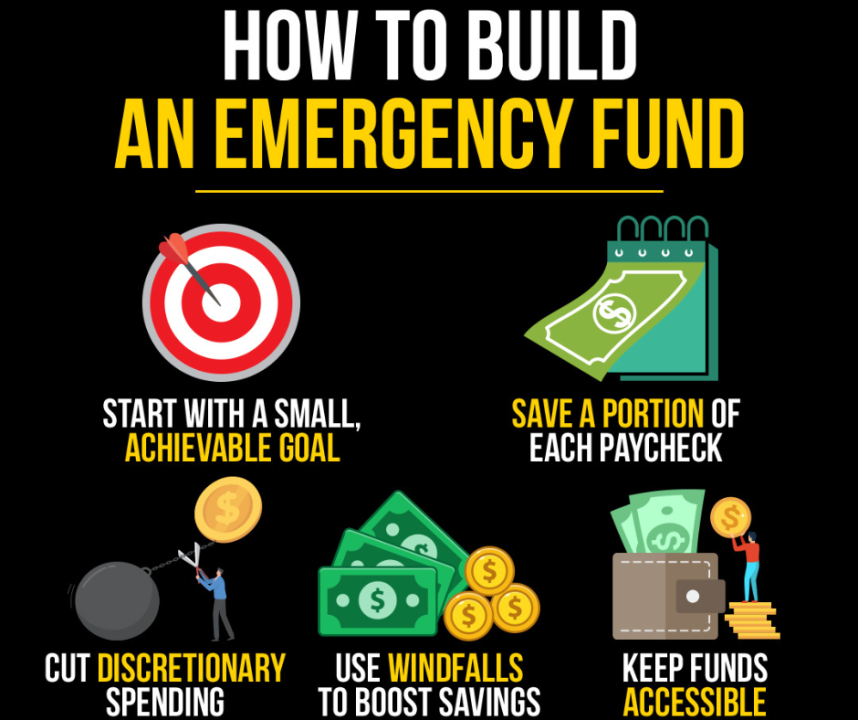
Step 1: Set a Micro-Goal for Your Emergency Fund
If you have $0 saved, do not begin by focusing on $15,000.
Set a first target of $500.
The purpose of the first $500 is not to make you financially independent. It is to create a small buffer between you and your next unexpected bill.
Once you reach $500, aim for $1,000.
After that, move toward one month of essential expenses, then three months and eventually six months if your circumstances justify it.
For example:
$0 → $500 → $1,000 → one month → three months → six months.
If you save $50 every week, you will contribute $2,600 in a year. At $100 per week, that becomes $5,200.
Do not choose an amount so aggressive that you constantly have to withdraw the money again.
According to the CFPB, starting small is still worthwhile because even modest emergency savings can provide some financial protection.
Step 2: Audit Monthly Cash Flow to Find Non-Essential Leaks
Before saying, “I cannot afford to save,” look at where your money is actually going.
Review your bank and card statements for the last one or two months.
Look for recurring subscriptions, delivery fees, frequent takeout, unnecessary charges and purchases you barely remember making.
You do not need to cut every enjoyable expense.
Instead, ask:
“Would I rather have this expense, or would I rather have financial breathing room?”
Suppose you find:
$40 in unused subscriptions
$100 in unnecessary convenience spending
$60 in impulse purchases
$50 in avoidable fees
That is $250 a month.
You could redirect even $150 of it toward emergency savings and still keep some money for yourself.
The CFPB recommends tracking income and expenses to understand cash flow and identify opportunities to save.
The goal is not extreme budgeting.
It is finding money that is currently disappearing without adding much value to your life.
Step 3: Automate Emergency Fund Transfers on Payday
Saving manually sounds simple, but it is easy to forget.
By the end of the month, you may discover that there is nothing left to save.
Instead, automate the process.
If you receive your salary on the 25th, schedule an automatic transfer to your emergency savings shortly afterward.
You might start with $50, $100 or another amount that fits your budget.
According to the CFPB, automatic recurring transfers can make saving easier because they turn it into a consistent habit. The agency also recommends ensuring that transfers do not cause overdrafts or other account problems.
This creates a simple system:
Income arrives → savings transfer happens → remaining money is available for spending.
When your salary increases, consider increasing the transfer too.
If you receive a bonus, tax refund or other unexpected money, putting part of it into your emergency fund can accelerate the process.
Step 4: Choose the Right Vehicle for Your Emergency Savings
An emergency fund has a different purpose from an investment portfolio.
You need the money to be safe, accessible and reasonably productive.
For many people, this means using a dedicated savings account or high-yield savings account rather than stocks or cryptocurrency.
According to Investor.gov, emergency savings are generally kept in accessible savings products because the money may be needed quickly when an unexpected expense occurs.
For U.S. savers, eligible deposits at FDIC-insured banks are generally insured up to $250,000 per depositor, per insured bank, per ownership category.
That protection applies to eligible bank deposits, not stocks or cryptocurrency.
If you live outside the U.S., check the deposit-protection scheme in your country.
The important thing is not simply chasing the highest interest rate.
Your emergency fund should be available when you need it.
Step 5: Define What Counts as a True Emergency
This rule can prevent your emergency fund from becoming an everyday spending account.
A genuine emergency could include:
An unexpected medical expense.
A sudden loss of income.
An essential vehicle repair.
An urgent home repair.
Another major, necessary expense that could not reasonably have been planned for.
According to the CFPB, medical expenses, repairs and loss of income are common examples of situations emergency savings can help cover.
But predictable expenses are different.
Your annual insurance payment is not an emergency if you knew it was coming.
Neither is Christmas shopping, a planned holiday, an annual subscription or a birthday gift.
For predictable costs, create separate savings categories.
If you need $1,200 for an annual bill, saving $100 every month gives you the money without touching your emergency reserve.
Common Emergency Fund Pitfalls to Avoid
Do Not Invest Emergency Reserves in Stocks or Crypto
The biggest problem with investing emergency money is timing.
Imagine you lose your job while the stock market is down 25%. If your emergency fund is invested, you may have to sell at a loss to pay your bills.
According to Investor.gov, emergency savings should be readily accessible, while investing is generally intended for longer-term financial goals.
Your investments are designed to grow wealth.
Your emergency fund is designed to protect you.
Keep those jobs separate.
Do Not Leave Large Cash Reserves in a Zero-Interest Account
Accessibility is important, but keeping thousands of dollars in an account that pays no interest can mean missing out on potential earnings while inflation reduces purchasing power.
A suitable interest-bearing savings account can allow your emergency money to remain accessible while earning some return.
However, do not sacrifice liquidity just to chase a higher rate.
A slightly higher return is not useful if you cannot access the money when your car breaks down or your income suddenly stops.
Do Not Treat Predictable Expenses as Emergencies
This mistake is extremely common.
If you know the expense is coming, plan for it.
Insurance, annual memberships, school costs, holiday spending and predictable repairs can be funded through separate savings goals.
For example, saving $100 every month for a $1,200 annual bill means the expense is already covered when the payment arrives.
Your emergency fund remains untouched for genuine surprises.
What Should You Do After Reaching Your First Target?
Reaching $500 or $1,000 is not the end.
It is the foundation.
Your next target should usually be one month of essential expenses.
After that, work toward three months.
If your income is unstable, you have dependents or it could take a long time to find another job, six months or more may be appropriate.
Investor.gov notes that some people maintain enough savings to cover up to six months of income for emergencies such as sudden unemployment.
You should also revisit your target whenever your circumstances change.
A new child, higher rent, mortgage, job change or additional dependent can significantly increase your financial responsibilities.
The Real Purpose of an Emergency Fund
The biggest benefit of an emergency fund is not the number in your savings account.
It is the time and choices that money gives you.
If your car needs a $1,000 repair, you can deal with it without immediately borrowing.
If you lose your job, you have time to search for another one.
If an unexpected medical bill arrives, you have somewhere to turn before reaching for expensive debt.
According to the CFPB, emergency savings can help households recover from financial shocks and reduce reliance on credit cards and loans.
That is why the best emergency fund is not necessarily the biggest one.
It is the one you can consistently build, protect and actually access when life throws an unexpected bill at you.
Start with $500.
Then $1,000.
Then one month of essential expenses.
Keep going until your savings provide the level of protection your income and household actually require.
You are not saving for an emergency because you expect disaster.
You are saving so that when something unexpected happens, one bad month does not become a financial crisis.