BOJ’s Masu Says Bank Will Continue Raising Benchmark Rate
BOJ’s Masu Says Bank Will Continue Raising Benchmark Rate
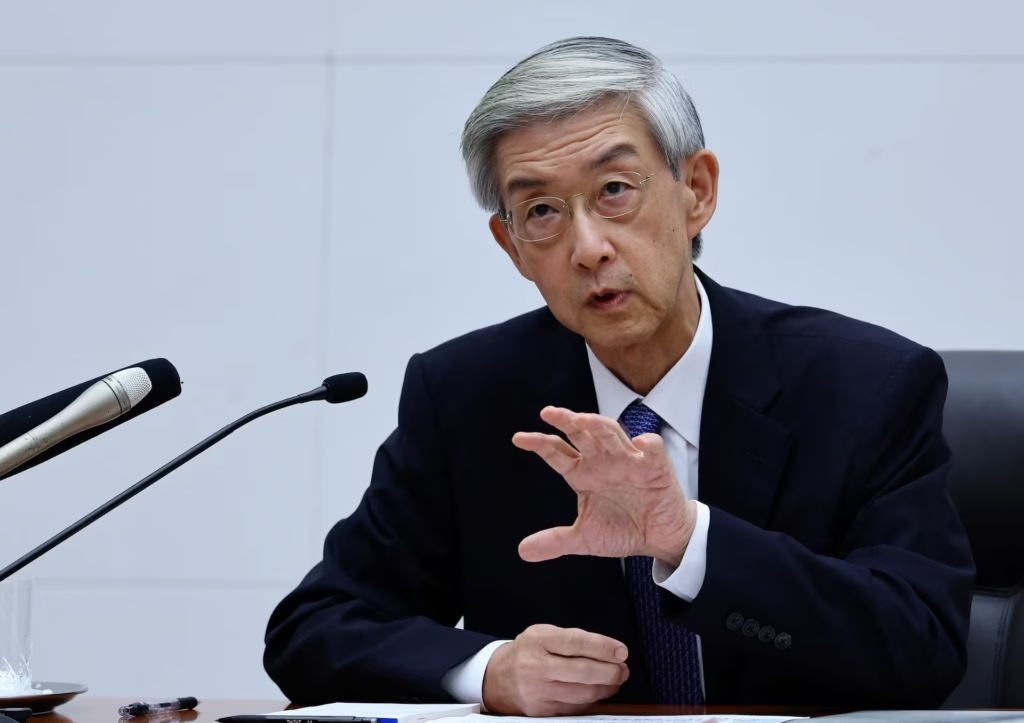
Bank of Japan board member Kazuyuki Masu said the central bank needs to raise interest rates further as financial conditions remain accommodative and underlying inflation moves closer to its 2% target.
The comments strengthen expectations that the BOJ will raise its benchmark rate next week after lifting it to 1% in June. Economists surveyed by Reuters expect the bank to increase the rate to 1.25% at its Sept. 17-18 meeting and to 1.75% in the second quarter of 2027.
Masu, speaking to business leaders in Fukui on Thursday, said the BOJ could eventually be forced to raise rates rapidly if inflation accelerates. He said recent increases in producer prices deserve attention because companies have been passing higher costs on to customers.
ALSO READ: Philippines Central Bank Sees Ample Funding for Borrowers
“Underlying inflation is about to reach 2%, but we don’t see it sharply overshooting that level,” Masu said at a news conference, adding that the BOJ’s priority should be to keep underlying inflation stable around its target.
The comments point to a gradual tightening path for now rather than an immediate acceleration. Masu said recent data do not show a large and rapid inflation overshoot, reducing the case for a 50-basis-point increase at the September meeting.
Still, he argued that the current policy rate remains too low relative to the BOJ’s estimate of where rates would neither stimulate nor restrain the economy. The central bank’s staff estimates Japan’s nominal neutral interest rate at between 1.1% and 2.5%.
“The BOJ’s policy rate remains below the estimated neutral range,” Masu said, arguing that rates need to move higher to give policymakers greater flexibility to respond to changing economic conditions.
ALSO READ: Brent Oil Surges Above $100 as Middle East Conflict Deepens
Japan’s inflation outlook has become more complicated as higher energy and food costs feed through the economy. Masu pointed to rising fuel and chemical prices linked to the conflict in the Middle East, as well as the impact of the weak yen on import costs.
A recent increase in producer prices could add to those pressures if businesses continue passing higher costs through to consumers. The BOJ is due to release its August producer-price data on Friday, offering another indication of whether those pressures are broadening.
Masu also said real interest rates should be lifted out of negative territory as soon as possible. He warned that leaving financial conditions too loose could create risks in areas such as corporate investment even as the BOJ tries to support sustainable economic growth.
The yen has strengthened in September as expectations for a BOJ rate increase have increased. A stronger currency could help reduce the cost of imported energy and other goods, although renewed increases in crude prices could work in the opposite direction. Brent crude was holding above $100 a barrel on Thursday amid heightened tensions in the Middle East.
Masu did not provide specific guidance on the timing or pace of rate increases beyond the immediate policy outlook. He said future decisions would depend on the likelihood of achieving the BOJ’s economic projections as well as risks from oil prices, artificial-intelligence-related demand, and currency movements.
For markets, the next move is increasingly well anticipated. The more important question is whether the BOJ follows a gradual path toward the neutral range or begins tightening more quickly if inflation proves more persistent.
Masu’s remarks suggest policymakers are preparing for both possibilities. For now, the BOJ can continue raising rates cautiously. But if inflation accelerates while financial conditions remain loose, the central bank may have to move much faster.