Why Oil Can Stay Below $100 Even With a Serious Gulf Supply Shock

Why Oil Can Stay Below $100 Even With a Serious Gulf Supply Shock
Makon Financials Analysis | by Victor Brooks
Brent crude is getting close to $100 a barrel, but the oil market is not behaving as if the world has suddenly run out of crude.
Brent was trading around $97.49 on Tuesday as concerns over the Strait of Hormuz intensified. Traffic through the waterway has slowed again after Iran threatened retaliation against the United States, adding another layer of uncertainty for tankers moving through the Gulf.
The physical market is already showing much more stress. Some physical crude prices have moved above $100, while benchmark futures have remained below that level. That gap tells us something important: traders are worried about the availability of barrels in specific locations, but they are not yet convinced that the disruption will remove enough oil from the global market for long enough to create a much larger worldwide shortage.
The biggest reason Brent has not exploded higher is simple: oil is still moving.
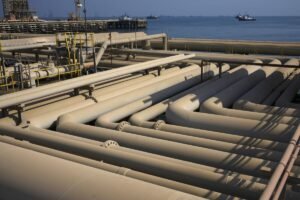
Traffic through Hormuz has fallen sharply, but the waterway has not stopped completely. Reuters reported that only seven commodity vessels crossed on Monday, compared with eight the previous day. Some vessels may also be moving with their tracking systems switched off, meaning the visible numbers may not capture every crossing.
There are also other ways for Gulf producers to get barrels out.
Saudi Arabia and other producers can use alternative ports and routes, while some cargoes can be moved through routes that avoid the most difficult part of the disruption. Those options can not replace Hormuz overnight, but they can prevent the market from losing every affected barrel at once.
That matters enormously for the futures market.
If traders believe 10 million barrels are temporarily delayed but will eventually reach buyers, the reaction is very different from believing those barrels have permanently disappeared from supply.
Demand is doing some of the work
There is another side to the equation that is easy to miss during a geopolitical crisis.
Oil demand is not fixed.
When crude becomes expensive and supply becomes difficult to obtain, refiners and consumers respond. Some buyers reduce purchases, some draw on inventories, and some switch to alternative supplies.
China is particularly important here. Reuters reported that weaker Chinese demand and large existing reserves are helping absorb part of the supply shock. That gives the global market more room to cope with disrupted Gulf exports than it would have if Chinese buying were accelerating at the same time.
This is one reason a major physical disruption does not automatically translate into a $120 or $150 Brent price.
The market adjusts.
More barrels are available outside the Gulf
The other cushion is production outside the region.
The United States, Canada, and Guyana are increasing output, while Russian exports have remained relatively resilient despite problems affecting some refining operations. Those barrels can not perfectly replace every Gulf grade or solve a shipping problem, but they help prevent the global supply balance from becoming even tighter.
That is also why looking only at the amount of oil that normally passes through Hormuz can be misleading.
What matters for price is not simply how much oil normally uses the route. It is how much of that oil is actually unavailable to the market after alternative routes, inventories, production changes, and weaker demand are taken into account.
That number is smaller.
The bigger warning is in the physical market
This is where the current situation becomes more uncomfortable.
Brent may still be below $100, but physical crude is telling a tighter story.
Some prompt physical barrels are trading above the futures benchmark, showing that buyers who need oil now are paying a much higher price than the headline Brent number suggests. Reuters has also reported strong premiums in physical Middle Eastern crude markets.
If the physical market remains tight while futures prices stay relatively contained, the question eventually becomes how long inventories and alternative supply can continue absorbing the pressure.
If they can, Brent may stay below $100.
If they cannot, the futures market has room to catch up.
RELATED ARTICLES:
- Oil Nears $100 as Gulf Supply Risks Grow After Hormuz Traffic Slows
- UBS Forecasts Two Fed Rate Hikes in 2026 After Strong U.S. Jobs Report
- Global Food Prices Hit Highest Level Since 2022 as Sugar Surges 11.9%
What could push Brent firmly above $100?
The next move will probably depend less on another dramatic headline and more on whether the physical disruption gets worse.
If Hormuz traffic falls further and stays depressed, the calculation changes.
If more tankers stop entering the Gulf, if alternative export routes become unavailable, or if attacks spread to additional energy infrastructure, the amount of crude actually reaching buyers could fall much faster.
At that point, inventories become more important.
So does China.
If Chinese refiners return to the market aggressively while Gulf supply remains constrained, the spare barrels currently helping the market disappear more quickly. That combination would make a sustained move above $100 much easier.
There is also the refining problem. Disruptions in the Middle East and Russia have tightened diesel supplies, and refined products are showing considerable stress. That can feed back into crude demand because refiners are willing to pay more for feedstock when product margins are strong.
What investors should know
The headline number to watch is still Brent, but it is not the only number that matters.
Investors should pay close attention to Hormuz traffic because fewer crossings mean fewer barrels moving through the main export route.
They should also watch physical crude premiums. If prompt barrels continue trading at unusually large premiums to futures, it would suggest that the shortage is becoming more immediate.
Chinese crude imports and inventories matter, too. Stronger Chinese buying would remove one of the cushions currently keeping the market from tightening further.
And perhaps most importantly, watch the duration of the disruption.
A shipping problem lasting several days is manageable. A disruption lasting weeks or months is a different market..
Brent can remain below $100, even while the physical oil market becomes increasingly uncomfortable. The real existing buffers can absorb the shock.
For now, they are still working.
But the margin is getting thinner.