UAE and Egypt Renew 5 Billion Dirhams (69 Billion Egyptian Pounds) Currency Swap Agreement for Five Years
The renewed arrangement could make cross-border transactions between the two markets more flexible while giving financial institutions another channel for managing local-currency liquidity.
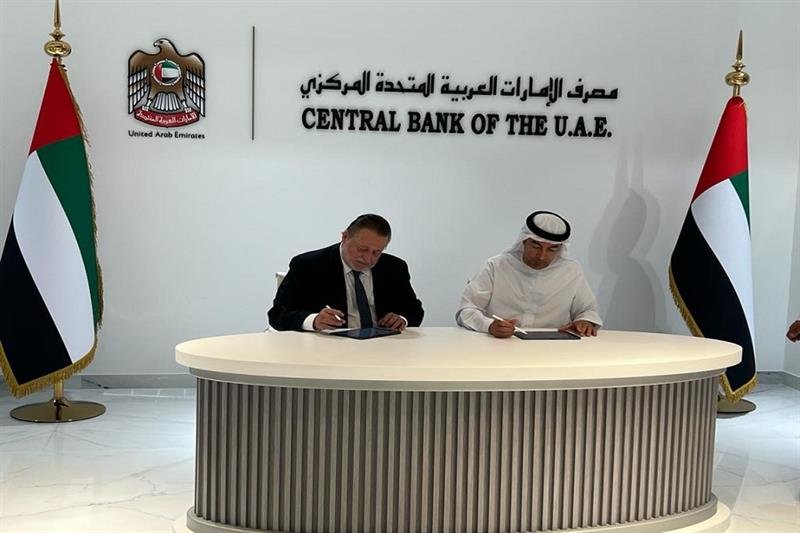
The Central Bank of the UAE and the Central Bank of Egypt have renewed their currency swap agreement worth AED 5 billion, equivalent to EGP 69 billion, for another five years. The agreement was renewed on September 29 at the Central Bank of the UAE headquarters in Abu Dhabi. It was signed by CBUAE Governor Khaled Mohamed Balama and CBE Governor Hassan Abdalla.
The agreement covers the UAE dirham and Egyptian pound and is aimed at supporting trade and investment between the two countries while expanding the use of local currencies in bilateral financial settlements. Both central banks said the renewed arrangement will also strengthen financial and banking cooperation and support economic development in the UAE and Egypt.
The agreement was originally signed in September 2023 with a nominal value of AED 5 billion and EGP 42 billion. The dirham value remains AED 5 billion under the renewed agreement, while the Egyptian-pound equivalent has increased to EGP 69 billion. The renewal comes as economic ties between the UAE and Egypt continue to expand.
The two countries have maintained strong trade and investment relations, with the UAE among Egypt’s major Arab economic partners. The renewed swap agreement gives the two central banks a framework for providing access to each other’s currencies and supports the use of local currencies in bilateral trade and financial transactions.
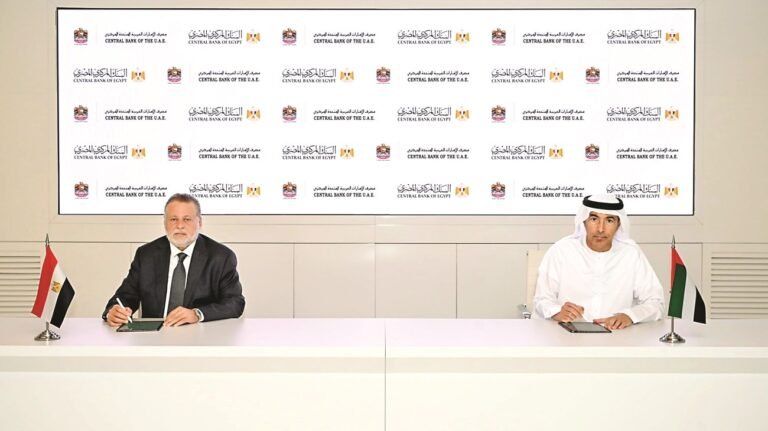
According to the CBUAE, the arrangement is also expected to facilitate trade and investment flows and contribute to financial stability in both countries. CBUAE Governor Khaled Mohamed Balama said the renewal reflects the continued development of financial and banking cooperation between the two countries.
ALSO READ
CBE Governor Hassan Abdalla said the agreement would support greater use of local currencies in trade and financial settlements and create additional opportunities for cooperation in finance and investment. The renewed currency swap, therefore, adds another layer to the financial relationship between the two markets, alongside their existing trade, investment, and capital-market links.
What This Could Mean for Business
For companies trading between the UAE and Egypt, the significance is ultimately practical.
If local-currency settlement becomes more widely used, businesses could have an additional route for managing payments between the two markets.
That could be relevant to importers, exporters, banks, and investment firms operating across both economies.
However, the agreement alone does not guarantee cheaper transactions or eliminate currency risk. Companies will still have to consider exchange rates, banking costs, liquidity conditions, and the availability of local-currency settlement channels.
It Also Shows Where Gulf-Africa Finance Is Heading
The UAE-Egypt agreement fits into a broader development in which Gulf financial centres are building deeper links with African economies.
Currency swaps, payment-system connections, and local-currency settlement arrangements can gradually create more direct financial channels between markets.
For Africa, the importance is not necessarily about replacing the dollar overnight. It is about having more options for conducting cross-border commerce.
For Gulf economies, deeper financial links can support their growing role as sources of capital, investment, and financial services across African markets.
Makon Financials





