Saudi Arabia’s PIF Replaces New Murabba CEO as Project Faces Delays and Rising Costs

Saudi Arabia’s PIF Replaces New Murabba CEO as Project Faces Delays and Rising Costs
Saudi Arabia’s Public Investment Fund has replaced Michael Dyke as chief executive of New Murabba, appointing PIF veteran Sabah Barakat as acting CEO as the sovereign wealth fund reassesses major projects across its portfolio.
The leadership change was reported by the Financial Times on Friday, citing people familiar with the matter. Barakat is also acting chief executive of Roshn, another PIF-backed real estate company.
The move comes as PIF reviews more than 100 portfolio companies after a number of developments have faced delays and cost overruns. The fund is under increasing pressure to priorities capital and demonstrate stronger returns after years of heavy investment.
YOU CAN ALSO READ:
Business Insurance in the United States: Types, Costs and What Businesses Need to Know
Why Michael Dyke Was Replaced
Dyke was appointed chief executive in December 2023, taking up the role in January 2024. Before joining the Riyadh development, he held senior positions at major infrastructure companies and was involved in Britain’s HS2 rail project.
The Financial Times reported that the change followed concerns over delays and rising costs, particularly around the project’s centrepiece, the Mukaab.
A person familiar with the matter told the FT that costs associated with the Mukaab had increased by about 100%, while progress had stalled. That figure has not been presented by PIF as an official revised budget, so it should be treated as a reported estimate rather than a confirmed project cost.
New Murabba Development Company said Barakat’s appointment was made in accordance with its governance framework and was consistent with its long-term strategic plans. It added that its operations, partnerships and strategic direction remain in place.
What Is New Murabba?
The development is one of the major Riyadh projects being backed by PIF under Saudi Arabia’s Vision 2030 programme.
Its plan is to create a new mixed-use downtown combining homes, offices, hotels, retail, entertainment and cultural facilities across a 19-square-kilometre site in northwest Riyadh. PIF says the development will contain more than 25 million square metres of floor area, including more than 104,000 residential units and 9,000 hotel rooms.
At the centre is the Mukaab, a planned 400-metre-high, 400-metre-wide and 400-metre-long cube-shaped landmark designed to house hospitality, retail, entertainment and immersive experiences. PIF describes it as one of the world’s largest built structures.
The wider development was launched in February 2023 as part of the kingdom’s effort to expand Riyadh’s economic and urban footprint beyond its traditional role as the country’s political and administrative centre.
Mukaab Delays Put Pressure on the Project
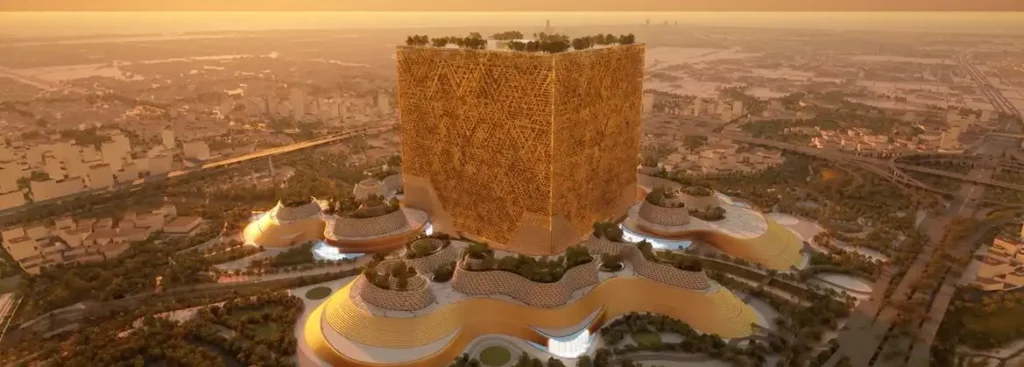
The Mukaab has become the most visible test of whether the original scale and timetable can be delivered.
The FT reported that work on the landmark had stalled and that its estimated cost had risen by roughly 100%, according to a person familiar with the project. The report also said the broader master plan had been approved and was expected to proceed on a staged basis.
The distinction matters.
The reported problems surrounding the Mukaab do not amount to an announcement that the entire Riyadh development has been cancelled. Instead, the latest reporting points to a more selective approach to construction and capital deployment.
That fits with the wider changes taking place inside PIF as it reassesses the timing and priorities of some of its large investments.
PIF Shifts Focus Toward Capital Discipline
PIF has spent the past decade financing projects designed to accelerate Saudi Arabia’s economic diversification.
Its investments span real estate, tourism, infrastructure, technology, sports and other sectors intended to create new industries and reduce the kingdom’s dependence on oil.
The scale of that spending has also created a much larger capital-management challenge.
The FT reported that the fund has been reviewing more than 100 companies and projects, with some facing delays, cost overruns or changes in scope. The review comes as PIF places greater emphasis on returns and on deciding which investments should receive priority.
The fund’s own 2026–2030 strategy describes the next phase as a move toward “value realization”, with greater emphasis on performance, innovation and maximising long-term returns.
That provides useful context for the leadership change.
Sabah Barakat Takes Over as Acting CEO
Barakat has previous experience with the development.
New Murabba’s announcement of Dyke’s appointment in 2023 identified Barakat as acting CEO at the time and credited him with helping establish the management team, develop the concept master plan, progress the Mukaab’s design, award major project-management contracts and begin site works.
He later moved into a senior role at PIF and is now also acting CEO of Roshn. His return to the top position gives the fund an executive with direct knowledge of the project and experience within its own portfolio.
The appointment therefore comes at a point when the focus is shifting from the original ambition of the project toward execution, sequencing and capital allocation.
The Riyadh Development Is Still Moving Forward
Despite the reported delays, PIF has not announced a cancellation of the project.
The fund continues to describe the development as a major part of Riyadh’s future urban expansion, with the master plan centred on residential, commercial, hospitality, cultural and entertainment uses.
The project’s long-term economic rationale also remains tied to Vision 2030. When it was launched, PIF said the development was expected to contribute SAR180 billion to Saudi Arabia’s non-oil GDP and create 334,000 direct and indirect jobs by 2030.
The immediate question is therefore less about whether Riyadh’s transformation will continue and more about how quickly its largest developments can be delivered without allowing costs and timelines to run beyond what PIF considers acceptable.
For investors and businesses watching Saudi Arabia, the CEO change offers a clearer signal of where the kingdom’s megaproject strategy is heading: the ambition remains large, but capital allocation and execution are becoming more important than simply announcing projects at scale.
Source: Financial Times





