CBDC vs Stable Coins: What’s the Real Difference for Digital Payments?
CBDC vs Stable coins: What’s the Real Difference for Digital Payments?
The debate around CBDC vs stablecoins is no longer limited to the crypto industry. Banks, governments, payment companies and investors are now asking a bigger question: what should digital money actually look like?
Both CBDCs and stablecoins can move money electronically. Both can support faster payments, programmable transactions and potentially cheaper cross-border transfers. But they are built on very different foundations.
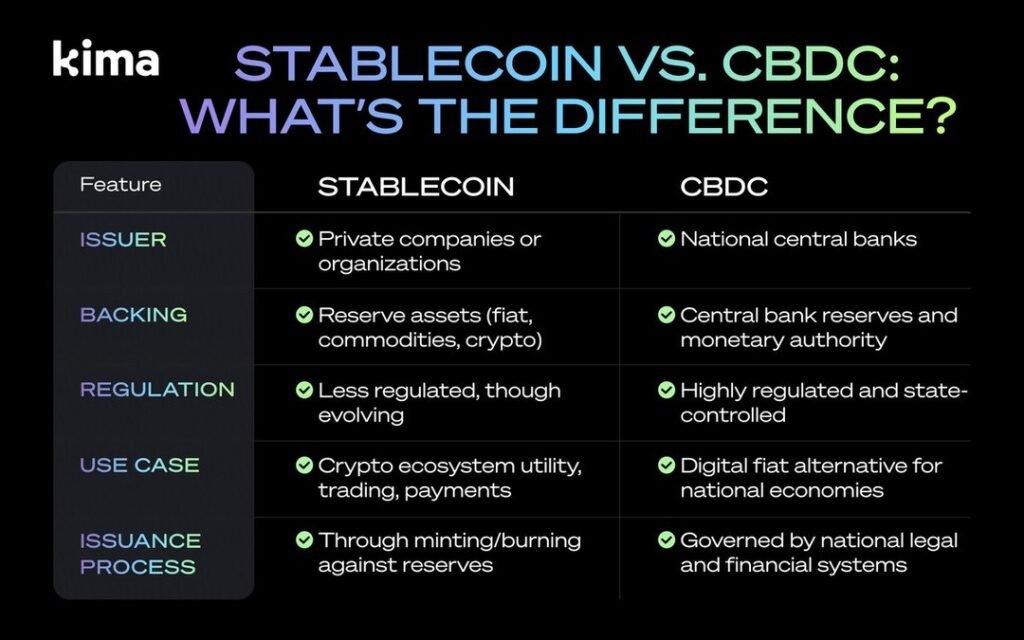
A CBDC, or central bank digital currency, is digital money issued by a central bank. A stablecoin is a privately issued digital asset designed to maintain a relatively stable value, usually against a currency such as the US dollar.
That difference in who issues the money affects almost everything else, including risk, regulation, privacy, settlement and how the money can be used.
According to the Bank for International Settlements (BIS), stablecoins have potential for faster and programmable payments, but their private issuance and reserve structures also raise questions about financial integrity, monetary sovereignty and financial stability.
So the real CBDC vs stablecoins debate is not simply about which one is faster.
It is about who controls the money, who carries the risk and what role private companies and central banks should play in the digital payment system.
What Is a CBDC and Why Does the Issuer Matter?
A CBDC is essentially a digital form of a country’s official currency issued by its central bank.
The important part is the issuer.
Money held in a normal commercial bank account represents a claim against the bank. A CBDC, by contrast, represents a direct claim against the central bank.
That distinction matters because it changes where the underlying credit risk sits.
If a central bank issues the digital currency, users are dealing directly with central bank money. If a private company issues a stablecoin, users depend on that company’s reserves, redemption arrangements, technology and regulatory framework.
The Reserve Bank of Australia has similarly described a CBDC as a potential form of digital money representing a claim on the central bank.
That is why the issuer sits at the centre of the CBDC vs stablecoins debate.
How Stablecoins Work Is Different From CBDCs
Stablecoins are privately issued digital assets designed to maintain a relatively stable value, most commonly by referencing a fiat currency such as the US dollar.
The way they maintain that value depends on the specific stablecoin.
Some are backed by cash, bank deposits or short-term government securities. Others have historically relied on different reserve structures or stabilization mechanisms.
The Riksbank describes fiat-referenced stablecoins as digital assets using distributed-ledger technology that are designed to maintain a stable value against their reference currency.
That means a stablecoin can behave like digital cash when making a payment, but it is not economically identical to central bank money.
The Federal Reserve’s analysis of the US payment-stablecoin framework also highlights the distinction. Qualifying payment stablecoins are designed to maintain a one-to-one value against the dollar and are backed by specified reserve assets.
Put simply:
A CBDC is public digital money.
A stablecoin is private digital money designed to track the value of another asset, usually a currency.
That difference becomes much more important once these assets are used at scale.
CBDC vs Stablecoins: Which Is Better for Digital Payments?
There is no single answer because each system is designed to solve different problems.
A CBDC for digital payments could be built around domestic payments, public infrastructure, financial inclusion and monetary sovereignty. Depending on its design, governments could potentially use it for benefits, tax payments and other public transfers.
Stablecoins operate differently.
They have emerged largely through private markets and blockchain networks, allowing users to move digital assets between wallets without necessarily relying on the same payment infrastructure used by traditional banks.
The European Central Bank has highlighted how stablecoins can move monetary value outside traditional banking channels and potentially reduce intermediaries involved in certain transactions.
That flexibility is one reason stablecoins have attracted attention from payment companies, crypto platforms and businesses operating internationally.
But flexibility also brings trade-offs. Stablecoin users still have to consider the issuer, reserves, redemption process, compliance requirements and the reliability of the underlying blockchain infrastructure.
Why Stablecoins Could Have an Edge in Cross-Border Payments
This is where the CBDC vs stablecoins debate gets particularly interesting.
A CBDC is generally connected to the monetary system of a specific country. Moving it across borders can therefore require cooperation between central banks, compatible payment infrastructure, foreign-exchange arrangements and common regulatory standards.
Stablecoins can operate on blockchain networks that are already designed to transfer digital assets across jurisdictions.
For example, an international business could receive a dollar-denominated stablecoin from a customer abroad and settle the transaction on a blockchain rather than relying entirely on traditional correspondent banking channels.
That does not automatically make stablecoins cheaper.
There can still be blockchain fees, conversion costs, compliance requirements and costs associated with converting the stablecoin back into fiat currency.
But the underlying architecture gives stablecoins an advantage in some cross-border payment situations.
Are CBDCs Safer Than Stablecoins?
From a credit-risk perspective, the difference is significant.
A CBDC is a direct liability of the central bank. A stablecoin is connected to a private issuer and the assets or mechanisms supporting its value.
That means stablecoin risk does not disappear simply because the token is designed to remain worth $1.
The BIS has raised concerns that stablecoins may not fully provide some of the properties traditionally associated with money, particularly as their use expands across financial markets and jurisdictions.
The history of digital assets has also shown that maintaining a stable peg is not just a technical exercise. Users need confidence that the issuer has sufficient reserves, that those reserves are properly managed and that redemption will work when demand rises.
For anyone holding a stablecoin, the practical question is therefore simple:
What exactly stands behind the token in my wallet?
With a CBDC, the answer is the central bank.
With a stablecoin, the answer depends on the issuer and its structure.
CBDC Digital Payments Raise a Different Privacy Question
Privacy is one of the biggest issues surrounding CBDC digital payments.
Digital transactions can potentially create much more data than physical cash. The important question is who can access that information and under what circumstances.
A CBDC does not automatically mean that governments would have unrestricted access to every transaction. The actual level of privacy would depend on the system’s architecture, legislation and operating rules.
But privacy has to be considered during the design process rather than added later.
The World Bank has identified privacy and data protection among the issues that can arise during CBDC implementation, alongside financial stability, financial integrity and cyber resilience.
Stablecoins are not automatically private either.
Blockchain transactions can be publicly visible, while regulated issuers, exchanges and payment providers may have customer-identification and anti-money-laundering obligations.
So the popular argument that stablecoins equal privacy while CBDCs equal surveillance is too simple.
The real issue is how each system is designed and regulated.
Could CBDCs and Stablecoins Exist Together?
Yes. In fact, that may be the more realistic outcome.
The financial system does not necessarily need one form of digital money to completely replace every other form.
A CBDC could serve as a public digital settlement asset, while stablecoins compete through user experience, programmability and international accessibility.
There is also another important category gaining attention: tokenized bank deposits.
These could allow commercial banks to place traditional deposit money onto programmable digital infrastructure without turning those deposits into direct central bank liabilities.
That creates the possibility of a financial system where CBDCs, stablecoins, tokenized deposits and traditional bank money operate alongside one another.
The Biggest Difference Between CBDCs and Stablecoins
Strip away the blockchain terminology and the distinction becomes much easier to understand.
A CBDC is digital money issued by and representing a liability of a central bank.
A stablecoin is a privately issued digital asset designed to maintain a stable value through reserves or another stabilization mechanism.
Both can support digital payments. Both can become programmable. Both could reduce friction in certain transactions.
But they represent different models of money.
CBDCs place the central bank at the centre of the digital-money system.
Stablecoins place private issuers, reserves and market infrastructure at the centre.
That difference matters far more than whether either asset uses blockchain technology.
What Victor Brooks Finds Most Important About CBDC vs Stablecoins
Victor Brooks’ view of the CBDC vs stablecoins question should be understood from the practical side of digital finance rather than simply treating it as a competition between two technologies.
The key issue is not which asset has the better branding or the more advanced blockchain.
It is who issues the money, who carries the risk, who controls the payment infrastructure and how easily that money can move.
That is also where the broader evidence from the BIS, Federal Reserve, ECB and other financial institutions points.
Stablecoins have a practical advantage because private companies can develop and launch them without waiting for a central bank to build an entirely new national payment system.
CBDCs have a different advantage: they can provide digital access to central bank money itself.
For banks and financial institutions, that distinction could become increasingly important as tokenization and programmable payments develop.
What the Future of Digital Payments Could Look Like
The biggest development may not be a winner between CBDCs and stablecoins.
Instead, financial markets could end up with several digital payment rails competing and connecting with one another.
Stablecoins already have a practical head start in some digital and cross-border transactions. CBDCs could eventually provide a public digital settlement layer for domestic economies and potentially international financial infrastructure.
Tokenized deposits could give commercial banks another route into the same digital environment.
The result could be a payment system where different forms of digital money serve different purposes.
For consumers, businesses and investors, the important question is therefore no longer whether digital money is coming.
It is which form of digital money becomes useful enough to matter in everyday payments, international transfers and financial markets.
And that competition is only beginning.