China Moves $54 Billion Into State Banks and Insurers to Reinforce Financial System
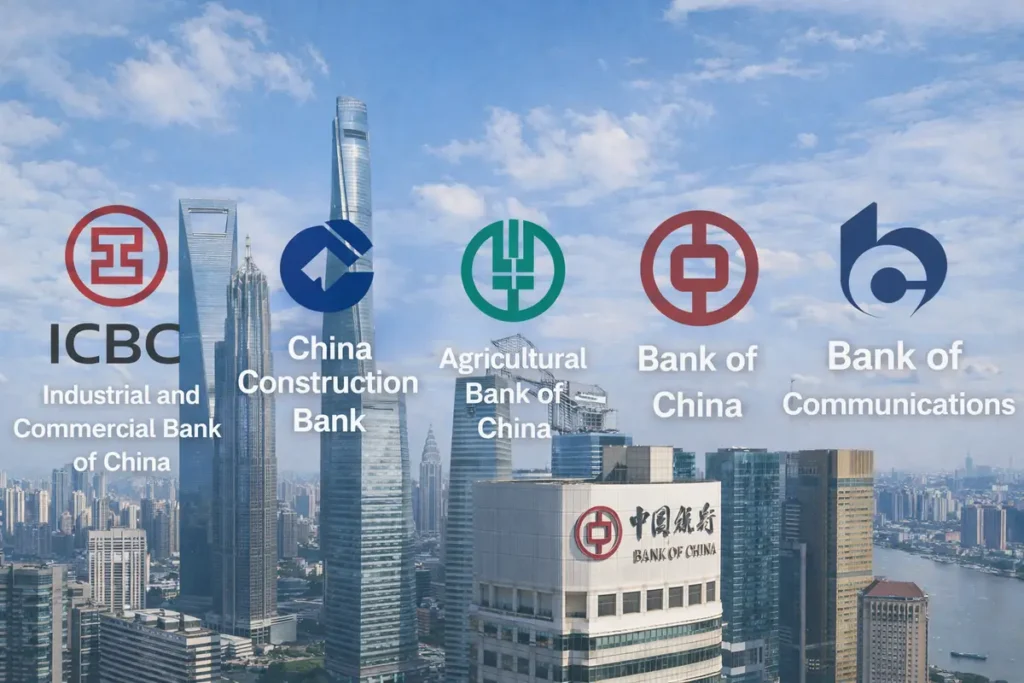
China Moves $54 Billion Into State Banks and Insurers to Reinforce Financial System
China is putting about $54 billion into major state-owned banks and insurers as Beijing moves to strengthen the financial system and give its largest lenders more room to support an economy still dealing with weak loan demand and pressure on bank profitability.
The coordinated capital push, led by the Ministry of Finance, covers major insurers including China Life Insurance Group and China Taiping Insurance Group, as well as three state-backed lenders. The plan combines direct government capital injections with private A-share placements.
The scale of the operation matters because China has been relying heavily on its state-owned financial institutions to maintain credit flows and support economic activity while private-sector borrowing remains subdued.
Agricultural Bank of China and Industrial and Commercial Bank of China, two of China’s largest state-owned commercial banks, will raise up to 160 billion yuan and 100 billion yuan respectively through private placements of A-shares.
That gives the two banks a combined capital-raising target of 260 billion yuan, or roughly $39 billion.
The shares will be placed with the Ministry of Finance, China National Tobacco Corporation and its relevant subsidiaries. Both banks said the proceeds will be used entirely to replenish their core Tier 1 capital, the highest-quality form of bank capital used to absorb losses and maintain financial resilience.
The Export-Import Bank of China will receive another 30 billion yuan directly from the Ministry of Finance.
Taken together, the three lenders are set to receive or raise 290 billion yuan in additional capital.
That is significant at a time when weak demand for loans has become a persistent problem for China’s banking industry. More capital does not automatically create borrowers, but it gives banks a stronger balance sheet from which to continue lending if credit demand improves.
Insurers Are Also Being Strengthened
The capital support extends beyond banks.
China Life Insurance Group, the country’s largest life insurer, will receive 35 billion yuan, equivalent to about $5.2 billion. China Taiping Insurance Group will receive another 7 billion yuan.
ALSO READ: Global Food Prices Hit Highest Level Since 2022 as Sugar Surges 11.9%
People’s Insurance Company of China plans to raise up to 15 billion yuan through a private placement of A-shares to the Ministry of Finance. China Export and Credit Insurance Corp will receive a 10 billion yuan capital injection, while China Reinsurance Group plans to raise 3 billion yuan.
The insurance sector has been under pressure from persistently low interest rates, which have weighed on investment returns and profitability. Reuters also reported that a number of smaller and mid-sized insurers have experienced deterioration in their solvency ratios.
For the larger state insurers, stronger capital positions can also support their role in China’s financial markets. Beijing has encouraged insurers to provide medium- and long-term funds to the stock market, while stronger institutions can give regulators greater capacity to deal with smaller, higher-risk insurers.
Why Beijing Is Doing This Now
The timing is closely linked to the condition of China’s economy.
Chinese banks are operating with weaker loan demand while profitability has come under pressure. At the same time, Beijing continues to expect state-owned lenders to provide credit and help support economic growth.
That puts pressure on bank balance sheets. Recapitalising the biggest lenders gives them a larger buffer while allowing policymakers to keep using the banking system as an important channel for economic support.
The recapitalisation programme was first unveiled at China’s annual parliamentary meeting in March. It extends an approach that was also used to strengthen other major state banks last year.
There is, however, a limit to what capital injections can accomplish.
More capital can make banks stronger, but it cannot by itself create demand for loans. If businesses remain cautious about borrowing and investment, lenders could continue facing pressure on margins even with healthier balance sheets.
That distinction is important for investors. The latest move improves the financial capacity of China’s largest state institutions, but the longer-term benefit will depend on whether stronger banks and insurers translate that capital into productive lending, investment and returns.
For Beijing, the immediate priority is less about generating a sudden burst of credit and more about ensuring that the country’s biggest financial institutions have enough capital to withstand pressure and continue supporting the economy.
The $54 billion package therefore represents a significant reinforcement of China’s financial system, but it also highlights the underlying challenge facing policymakers: strengthening banks can improve financial stability, but stronger balance sheets alone cannot solve weak demand across the wider economy.
Source: Reuters